

Emeka
A mid-career operations analyst working full-time who enrols in ADC certification tracks to move into a senior or specialist role. He studies evenings and weekends, squeezing sessions between shifts and family commitments.

Agile Digital College began as a landing-page brief and became a complete learning and operations ecosystem. Over six months, I helped turn a fragmented catalogue of professional courses into a custom platform through repeated exploration, testing, redesign, and refinement.
ADC had a scale problem. More than 50 courses, high-stakes certification tracks, enterprise clients, learners, and internal teams all needed a single source of truth. Generic course platforms could host content, but they could not express ADC's premium positioning or support the depth of its operation.
I designed a connected five-part ecosystem: a scalable CMS approach for course marketing, a gamified LMS, a career-growth hub, an enterprise suite, and an internal command centre. A shared system keeps the experience coherent while each surface remains focused on its user's job.
The work began by understanding the complete ecosystem, the people using it, and the moments where unclear structure created unnecessary friction.
Mapped the complete learning business across acquisition, delivery, career growth, enterprise, and operations
Audited recurring course structures to find what should become reusable rather than redesigned
Studied the motivation gaps that make conventional learning dashboards feel passive
Defined distinct information needs for learners, employers, and ADC's internal team
A useful product must understand what each person is trying to protect, avoid, and accomplish.

A mid-career operations analyst working full-time who enrols in ADC certification tracks to move into a senior or specialist role. He studies evenings and weekends, squeezing sessions between shifts and family commitments.

Manages professional development for a mid-size firm. She enrols teams in ADC programmes as part of annual training budgets and is accountable to leadership for completion rates and ROI.
The design process translated those findings into a clear, scalable system. Each stage reduced complexity while preserving the personality and purpose of the product.
Mapped every audience, product surface, and handoff to understand where one connected system needed to replace fragmented tools.
Established the deep-dark, electric visual direction and reusable foundations needed to make a large product feel precise and premium.
Designed flexible course templates and shared components so new programmes could launch without rebuilding the experience each time.
Tested, discarded, and rebuilt multiple versions of the critical journeys until course discovery, learning momentum, career growth, enterprise oversight, and daily administration worked as one system.
Kajabi or Teachable could host courses, but ADC's ambition crossed marketing, learning, career development, enterprise management, and internal operations. Treating those needs as one designed ecosystem created a defensible experience instead of another branded course portal.
The catalogue would keep growing. Category-level master templates created enough flexibility for every course to tell a distinct story while preserving a predictable conversion path and dramatically reducing future design and development effort.
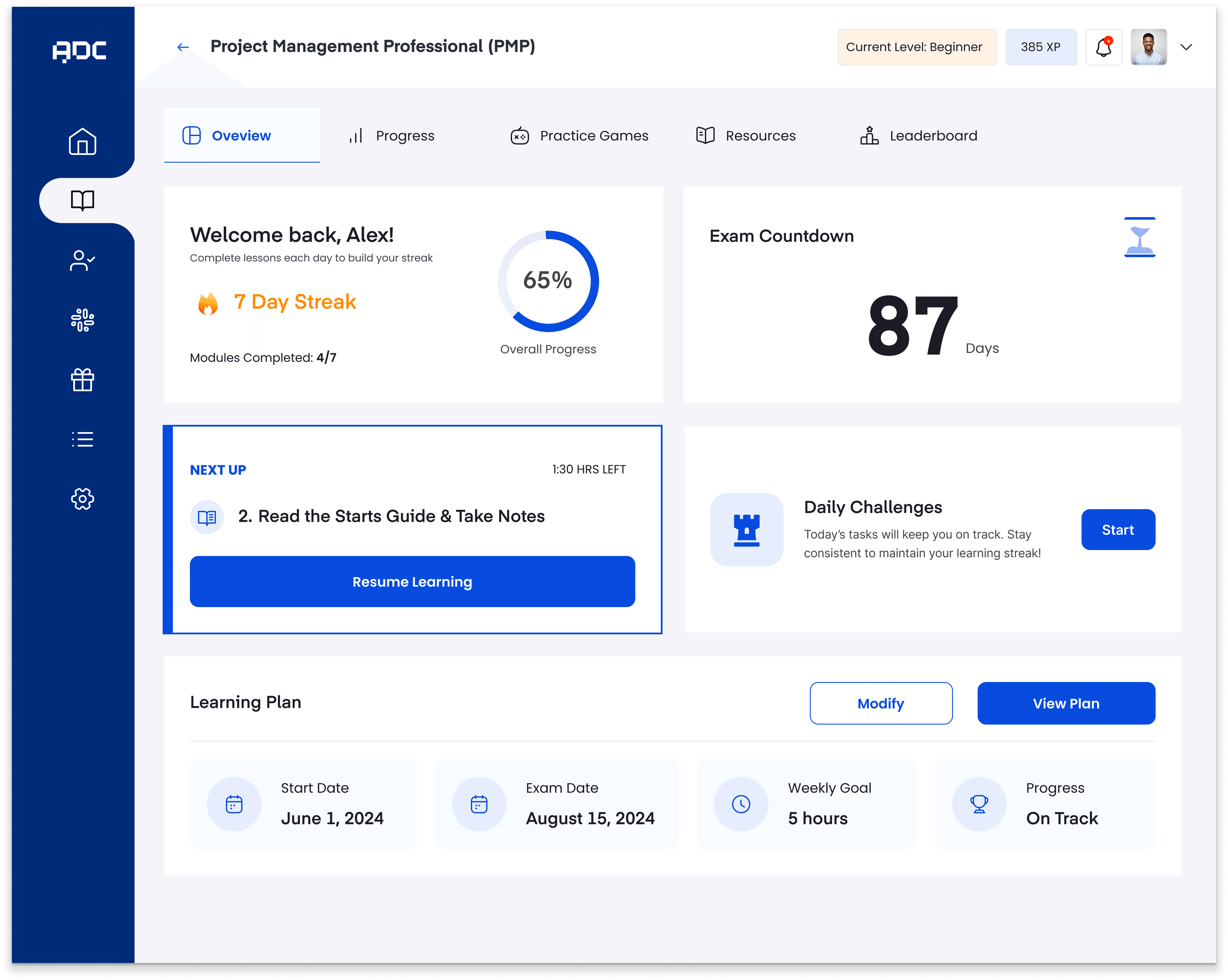
Completion percentages alone do not create momentum. Challenges, proficiency levels, badges, exam countdowns, and career-readiness feedback turn progress into a collection of meaningful signals learners can act on.
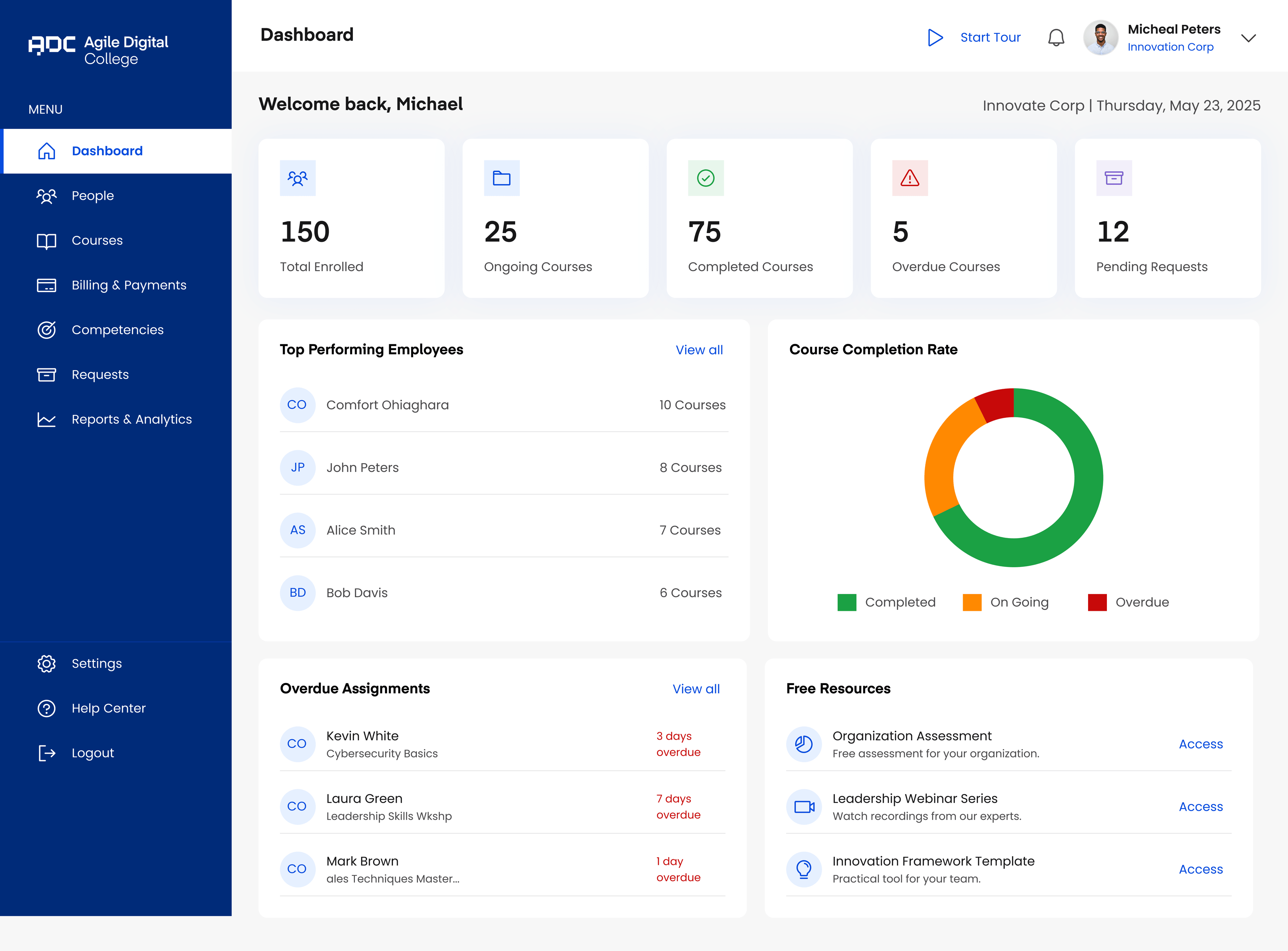
Learners, employers, and ADC operators have fundamentally different decisions to make. Dedicated surfaces let each audience see the right density, actions, and outcomes without inheriting everyone else's complexity.
A custom ecosystem needed more than a polished interface. It needed visual rules and product components strong enough to stay coherent across every learner, enterprise, and operations surface.
Blue creates trust and precision across learning and operations. Orange is reserved for momentum, emphasis, and the moments that ask learners to act.
Individually crafted geometric symbols make abstract ideas such as discovery, focus, growth, synthesis, and mastery recognisable across the product.
The experience had to sell learning, deliver it, connect it to career growth, serve enterprise clients, and give ADC control over the entire operation.
A template-led content system gave every course a premium identity while keeping the growing catalogue manageable for both design and development.
The learning environment was rebuilt as an engagement engine, replacing a passive video library with visible momentum and useful accountability.

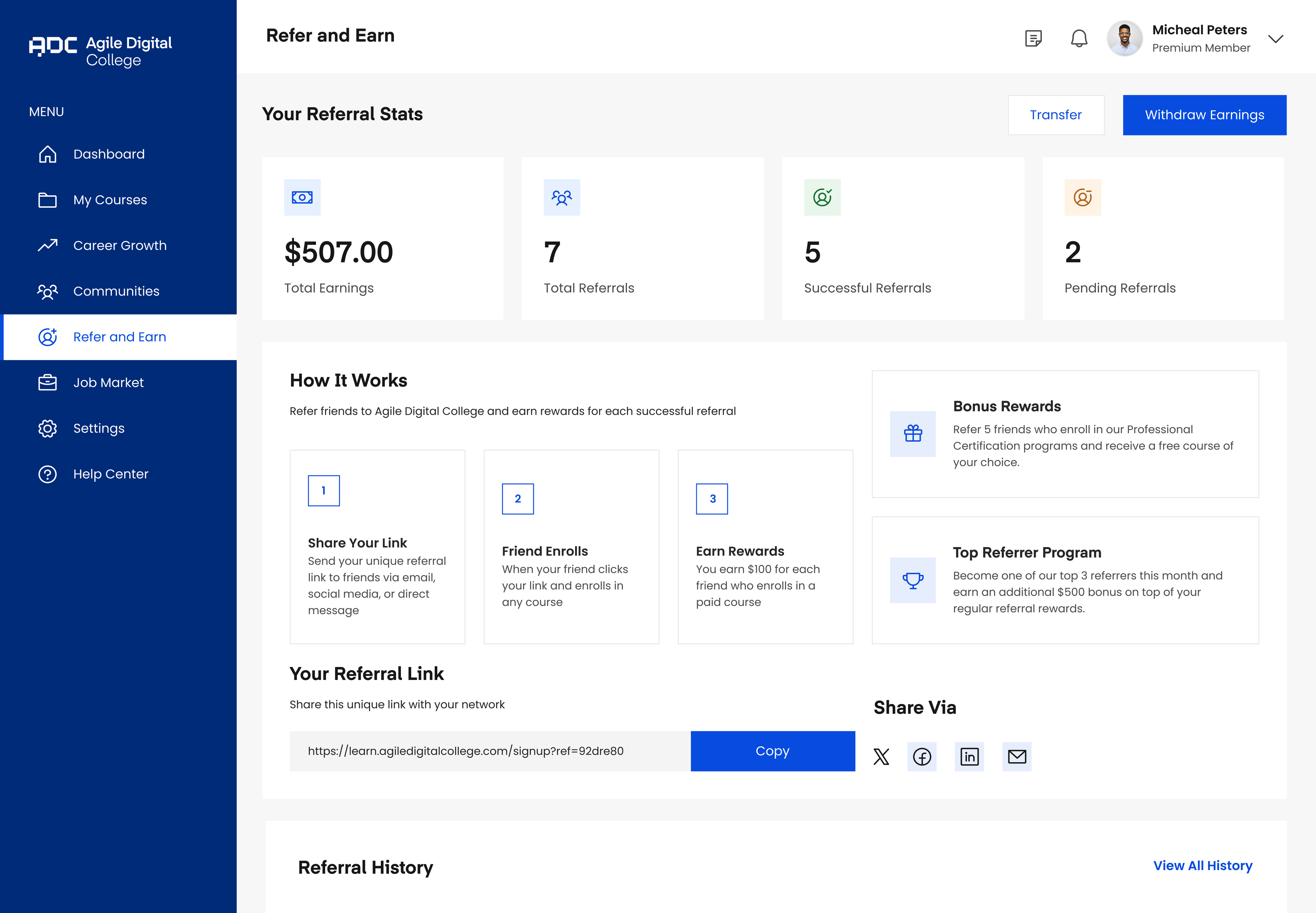
Learning outcomes were connected to the learner's bigger ambition: understanding their readiness, seeing their growth, and finding the next opportunity.

A dedicated B2B surface gives organisations the information and controls they need without forcing enterprise workflows into the learner product.

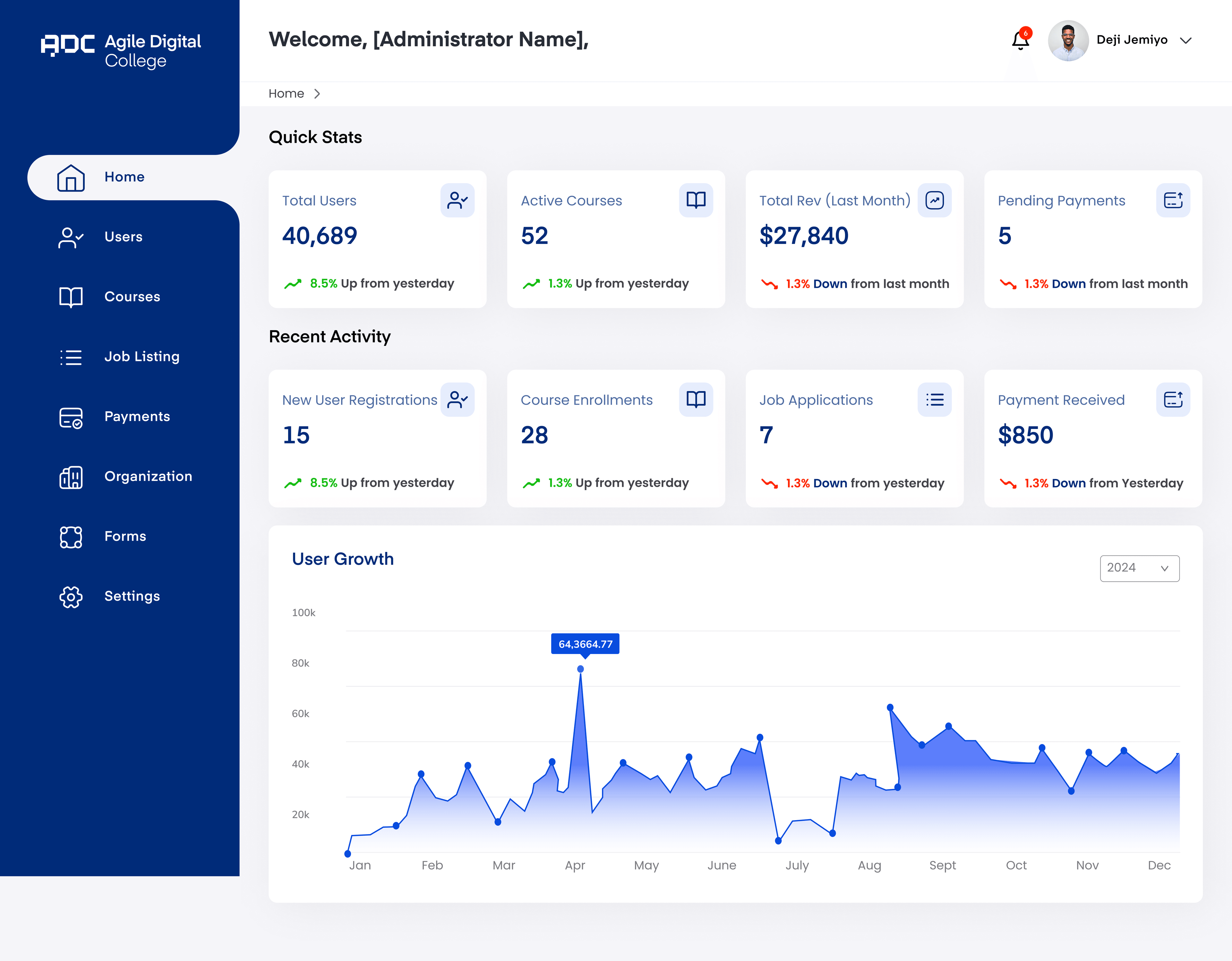
The internal team needed a high-density workspace that made a complex operation feel controlled, legible, and fast.

The strongest design systems encode business strategy, not only visual consistency. Reusable course structures were as important as colour and components.
Engagement is useful when it helps people make a better next decision. Every progress signal needed to point learners toward action.
Large ecosystems become clearer when each audience gets a focused surface and the shared logic stays underneath.
One connected product vision spanning acquisition, learning, career growth, enterprise, and operations
A reusable course-marketing system designed to scale beyond 50 programmes
A differentiated learning experience built around momentum rather than passive content consumption
Dedicated enterprise and back-office products that make the platform commercially and operationally scalable